RSS Feed
TOP

How to Get Hired - The Ebook

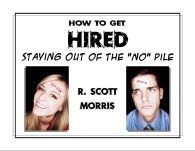
My free Ebook, How to Get Hired: Staying Out of the "No" Pile, is now yours to read, download, and share.

Learn inside:

  • The secret Four-Step Method recruiters follow to choose job candidates.
  • The checklists employers use to make hiring decisions.
  • The insider's step-by-step guide for success.


Please click the image below to view or download.


Enjoy!

-R. Scott Morris


TOP

Your Biggest Weakness

Q: How should we answer "tell me your biggest weakness"? I have heard we should work in a strength as the answer.

Bad advice. The “it's-a-weakness-but-really-a-strength” response will highlight a true weakness: a lack of self-awareness.

The purpose of this question is generally to learn about your character. Mature, self-aware people know what they do well and where they need support, and they have enough self-confidence to admit it.

In answering this question, you should not belabor the point or be self-deprecating, but you should answer the question honestly. Responses like, "sometimes I need help managing multiple deadlines" or "sometimes my first response is to act without thinking through thoroughly" are perfectly acceptable and will not hurt you.

Are you wondering How to Get Hired? Join the discussion on my Facebook Group Polished and ask me anything you have ever wondered about resumes, cover letters, interviews, and job hunting!

TOP

Surprise! Nobody Cares

Q: For interviews and cover letters, I've heard that the best way to show interest in a firm is to give historical facts (founding date, important deals) or logistics (number of employees). How often should we work these in?

Yikes, what bad advice. That is the last thing I want to hear. When I am reading your cover letter, I do want to know that your letter has been written specifically to answer my job description, and that it is not a form letter. Likewise, when I am assessing you in both your cover letter (and resume) and during your interview, I am looking for evidence that you would want to work for me and my firm.

But, regurgitated facts are not the way to show it.

Experiences and skills that are aligned with what I do are much more relevant to me. I am never going to leave an interview thinking, “Wow, she was able to name all three of our founders and knew when their birthdays were!” But you will be heading towards an offer if I am thinking “Wow, that research project she worked on covered exactly the type of problems we deal with every day!”

Dazzle me with your skills and evidence of interest in my industry; don’t bore me with memorized facts about my firm.

Are you wondering How to Get Hired? Join the discussion on my Facebook Group Polished and ask me anything you have ever wondered about resumes, cover letters, interviews, and job hunting!

TOP

Interviewers Love Their Competitors

Q: If an interviewer asks if I have applied to other companies, including competitors, should I be frank?

Yes, it is okay to tell them that you are interviewing with their competitors. This will actually give them some level of comfort, since it shows that you are focused on their particular industry.

But, don’t elaborate on the point; this is a common mistake. Keep it short and sweet. Since this is a general question, you only have to give a general response. Specifically, don’t go into detail about your other opportunities, their relative fit, and your assessment of them.

If someone asks you this level of detail—which they may near the offer stage of the process—keep it positive. Never “diss” another company – even to a perceived rival. This would be viewed as unprofessional.

Are you wondering How to Get Hired? Join the discussion on my Facebook Group Polished and ask me anything you have ever wondered about resumes, cover letters, interviews, and job hunting!
TOP

Changing Your Resume and Cover Letter

Q: Should I make a new resume for each company I apply to? How different should each cover letter be?

It is perfectly fine to customize your resume and cover letter for each opportunity. Your goal when doing this will be to highlight your particular skills and strengths as they relate to the individual opportunity. For example, if giving presentations will be a key part of the job, make sure your presenting experience and skills stand out over less related information.

Just be aware of the logistical problem of remembering which version went to whom.

With regard to cover letters, once you have done four or five of them, you usually have covered most iterations and can cut and paste the right pieces together. Keeping your information general, but tayloring it to each particular opportunity, is the best combination.

Are you wondering How to Get Hired? Join the discussion on my Facebook Group Polished and ask me anything you have ever wondered about resumes, cover letters, interviews, and job hunting!

TOP

Interview Skills are NOT Social Skills

Q: I keep being told that good interview skills are equivalent to good social skills. Isn't preparation basically for people who cannot carry on a normal conversation? I mean, we are just giving a few soundbites and talking about ourselves, right?

Well, I guess that would be equivalent to convincing yourself that you don't need to study for finals, because you "know the material". If you ever talked yourself into this frame of mind, you know how well it turned out. Expect the same level of success if you do not adequately prepare for your interviews.

Interviews are not a normal form of interaction. They are one of the most uncomfortable, nerve-wracking experiences you will ever endure. When caught off-guard with a question one is not prepared to answer, a common response is panic and a spewing of blabber from one's mouth. No social skills or any other innate ability will help you after this, but the confidence of being well-prepared will save you.

Be aware that you have very little time during an interview to present your case for why you should get the job. You have to be ready to articulate your top selling point under all the possible scenarios your interviewer may throw at you. You have to practice answering many iterations of possible questions and be able to deliver your message in a fluid--but not over-rehearsed--way.

Like everything else in life, you get better with practice. Interviewing is no different.

Are you wondering How to Get Hired? Join the discussion on my Facebook Group Polished and ask me anything you have ever wondered about resumes, cover letters, interviews, and job hunting!

TOP

Answering "Why This Industry?"

Q: How should I answer the infamous "Why are you interested in this field?" question?

First off, the general reason for this question is that the interviewer wants to determine how serious you are about the particular field he or she is interviewing you for. You typically will get this question if you are new to the field (for example, a career-changer or recent graduate). This is the number one uncertainty that we recruiters face with first-time job seekers; are they really serious about a career in health care or consulting or zoology? You guys are a big risk because most of you lack a track record that we can point to for guidance.

We are looking for you to mitigate this risk with your answer.

You want to address this concern head-on with proof that you understand what it means to be “a health care professional” or “zoologist”. You can do this by reiterating past experiences--or even conversations--that you have had that show that you are aware of what it will take to be successful in this career path. If you can speak to your passions and how this particular field touches them, all the better.

Are you wondering How to Get Hired? Join the discussion on my Facebook Group Polished and ask me anything you have ever wondered about resumes, cover letters, interviews, and job hunting!